





Artificial intelligence has moved from experimentation to expectation across financial services. Teams in investment banking, advisory, private equity, and asset management are under pressure to deliver more, faster, with fewer mistakes. Meanwhile, regulators, clients, and internal leadership expect airtight accuracy and clear audit trails in every interaction.
This shift is driving firms to invest in workflow‑specific, enterprise‑grade AI tools, rather than generic assistants. The solutions gaining real traction are those directly addressing the most time‑intensive parts of the dealmaking and reporting lifecycle.
In this blog, we’ll explore the best AI tools for finance in 2026 that are truly reshaping the way financial and professional services firms work.
Why AI Solutions for Financial Services Are Critical in 2026
AI usage in finance is no longer an experimental enhancement; it is a structural requirement for firms operating in investment banking, asset management, private equity, and broader financial services. Increasing deal complexity, compressed timelines, and stricter regulatory scrutiny have made traditional, manual workflows increasingly unsustainable.
Across the industry, financial institutions are expected to process more data, produce more deliverables, and maintain higher reporting accuracy than ever before. At the same time, clients and regulators demand transparency, consistency, and traceability in every document and decision. This combination of pressure has pushed AI in financial services from testing directly into the core of everyday workflows.
What to Look For in Finance-Specific AI Tools
Choosing the right AI solution in financial services requires more than just picking the most powerful model: it’s about selecting technology that enhances accuracy, reduces operational risk, and integrates seamlessly into the workflows your teams already rely on. Financial institutions operate in high‑stakes, regulated environments, so the best AI tools are those that combine technical sophistication, enterprise controls, and deep workflow understanding.
Here are the fundamentals every financial services team should prioritize:
- Accuracy and auditability: AI outputs must be explainable, verifiable, and backed by clear reasoning pathways.
- Enterprise‑grade security: SOC2/ISO compliance, encryption, and strict data governance should be built in, not added later.
- Industry‑specific workflows: Tools must understand and be purpose-built for pitchbooks, valuation models, fund reports, and regulatory contexts, not just generic documents.
- Seamless workflow integration: AI should slot into existing ecosystems like Microsoft 365, not force teams to adopt new tools or processes.
- Operational scalability and governance: Admin controls, usage policies, and consistency across global teams ensure AI can scale safely and predictably.
The Best AI Solutions for Financial Services
AI is no longer a “nice‑to‑have” in financial services; it has become embedded across the deal lifecycle, from early‑stage research to final client delivery. But unlike consumer AI, the tools that matter are those that genuinely reduce operational friction, enhance accuracy, and integrate into high‑pressure workflows.
Below is a curated list of the most relevant AI solutions used across investment banking, advisory, private equity, and asset management, each chosen for its real‑world applicability and enterprise‑grade approach.
Financial Modeling and Analytics
Alteryx
Alteryx automates repetitive data workflows and enhances analytical modeling – particularly useful for analysts, operations teams, and PMO functions. It’s widely adopted in financial services because it eliminates hours of manual data manipulation.
Where it adds value:
- Preparing valuation input datasets or scenario models
- Consolidating multiple data sources into a single analytical flow
- Running frequent “what‑if” analysis on deals or fund performance
- Standardizing repeatable modeling workflows across teams
Perfect for organizations where modeling accuracy and workflow standardization matter.
Portfolio Monitoring and Valuation Reporting
iLevel
S&P Global’s iLevel streamlines portfolio company data capture and reporting, which is particularly valuable for private equity and asset management firms. It centralizes input from multiple stakeholders and ensures consistency across reporting cycles.
Where it adds value:
- Quarterly valuation updates and reporting packs
- Tracking KPIs, financials, and operational metrics from portfolio companies
- Speeding up IC memo preparation and fund reporting
- Reducing time spent chasing disparate spreadsheets and emails
A strong fit for private equity and asset management teams managing high‑volume recurring reporting.
Document Creation, Review and Reporting
UpSlide
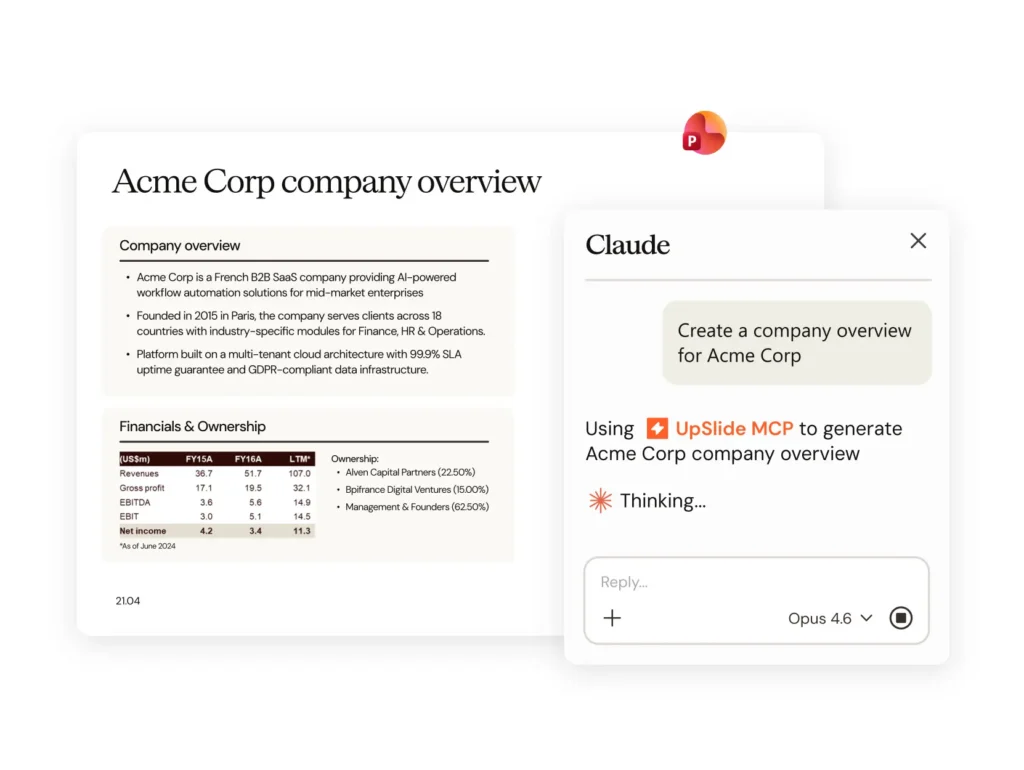
UpSlide is a document production layer built deep into Microsoft 365. It sits between draft creation – whether that is done by AI assistants, agents or humans – and the finished, client-ready deliverable. It connects directly to tools like Claude and Copilot via MCP, so teams get the speed of AI drafting on due diligence reports, investment memos, and pitchbooks without losing accuracy, traceability, or brand control.
Finance documents go through dozens of versions as partners and clients weigh in, and every touchpoint is a chance for numbers or narrative to drift. UpSlide retains visibility, control, and consistency across every version, not just the first draft. And, through a combination of AI, automation, and classic machine learning, it ensures AI tokens are used as efficiently as possible.
Where it adds value:
- Applies your firm’s templates and brand automatically to AI drafts before any tokens are spent
- Keeps every linked figure updated, traceable and auditable, with a record of what changed and when, across every version
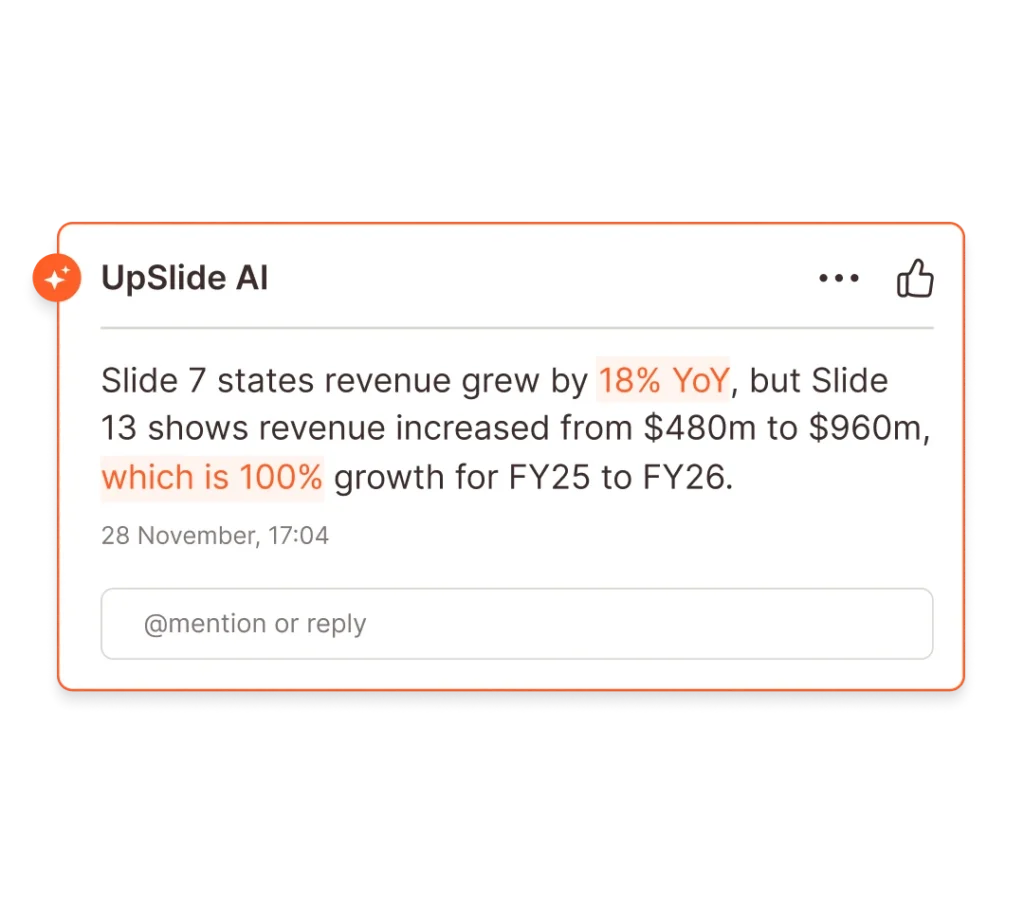
- Runs AI-powered checks to verify accuracy, consistency, and formatting – reducing the risk of errors reaching a client
- Lives inside Word, Excel, and PowerPoint, embedded in the daily M365 workflow
UpSlide lets analysts, associates, and senior leaders use AI for speed while staying in control as a document evolves – from first draft to client-ready.
Generalist AI Models Tailored to FS
ChatGPT Enterprise
The enterprise version of ChatGPT is increasingly used across the industry for knowledge retrieval, content summarization, light drafting, and linking to internal data repositories. With organization‑level governance and privacy controls, it becomes a safe LLM foundation.
Relevant use cases:
- Summarizing lengthy filings, research, or transcripts before a pitch
- Drafting emails, summaries, or briefing notes
- Accessing internal knowledge bases in a governed way
- Assisting junior staff with a quick explanation of financial concepts
Claude for Financial Services
Claude for Financial Services is now built directly into Word, Excel, and PowerPoint, with Outlook support in beta, and shares context across all of them: an analysis started in Excel on a comps set or fund model carries into the deck built in PowerPoint and the memo drafted in Word, without re-explaining anything. It also connects to financial data providers like S&P Global and LSEG via MCP. In practice, formatting a deck to firm-specific templates and brand guidelines still takes a fair amount of prompting and back-and-forth, and can burn through tokens quickly on repetitive tasks like reformatting or reapplying styles across slides.
Relevant use cases:
- Building and auditing financial models in Excel
- Drafting first-pass sections of an investment memo or due diligence report in Word/PowerPoint
- Pulling data from open files across a fund report or pitchbook to speed up analysis
- Saving repeatable processes as reusable Skills for tasks run often, like a standard comps pull
These LLMs are strongest when paired with data provider feeds and internal systems, and even more impactful when combined with tools like UpSlide.
Microsoft Copilot
Microsoft Copilot became a far stronger contender in financial services following a July 2026 upgrade: newer Anthropic and OpenAI models for tenants with them enabled, a Brand Kit feature for on-brand PowerPoint generation (PowerPoint only for now, not yet in Word or Excel), and custom skills in PowerPoint and Excel for repeatable workflows (personal to each user, not yet enterprise-controlled).
Relevant use cases:
- Drafting first-pass sections of investment memos or fund reports directly inside Word
- Summarizing due diligence findings, deal calls, or Teams meetings into working notes
- Generating an initial pitchbook or IM outline in PowerPoint, with Brand Kit selected
- Building personal custom skills in PowerPoint or Excel for recurring individual workflows
How to Select the Best AI Solution for Your Firm
By the time a financial institution begins shortlisting AI tools, the challenge often isn’t identifying what AI can do; it’s deciding how different tools fit together into a coherent, strategic stack. Most teams already use a mix of research platforms, modeling tools, and early‑stage AI assistants. The question now is how to turn these into a coordinated ecosystem that boosts accuracy, reduces operational drag, and supports deal velocity.
Here’s how to approach it:
Start with the workflows that matter most
Different teams – investment banking, advisory, private equity and asset management – experience friction in different areas. Pinpoint where delays or accuracy risks consistently creep in (e.g., due diligence, portfolio reporting, pitchbook review). Let these workflows shape your AI priorities.
Treat integrations as a multiplier, not a bonus
The most effective stacks are built around tools that extend the systems teams already use day to day. AI that plugs directly into Microsoft 365 doesn’t just save time, it accelerates adoption, reduces training needs, and keeps output consistent across global teams.
Build around control, not just capability
We’ve already covered accuracy and security, but here the emphasis is different: it’s about making sure administrators, not individual users, control how AI behaves. That means permission layers, templates, usage visibility, and governance that scale with your organization.
Use LLMs strategically, not everywhere
LLMs are powerful engines for idea generation, research, and first drafts, but they shouldn’t become the default solution for complex, high‑stakes workflows. Instead, deploy them where they enhance human judgment, and surround them with finance‑specific tools that impose structure and standards.
How UpSlide Fits in the Financial Services AI Ecosystem
AI assistants are getting finance teams to a first draft faster than ever. The problem is what happens next: someone still checks figures side by side, fixes formatting by hand, and manually reconciles numbers that should already match. That effort is the real cost of AI adoption, and it’s rarely counted.
UpSlide addresses this by sitting inside Microsoft 365 and connecting to AI assistants like Claude and Copilot through MCP (Model Context Protocol), an open standard that lets an assistant reach external tools and data without leaving the document.
That means:
- Context travels with the assistant. Left alone, an AI assistant has no idea which template your firm uses or which disclaimer applies to a given deal – someone has to supply that each time. Through MCP, UpSlide makes brand guidelines and approved library content available automatically, so drafts come back already formatted to your standards, and stay that way as the document goes through revisions.
- Work gets routed to the right engine. Updating dozens of linked figures across a report is not what language models were designed for, and adds unnecessary time and risk. UpSlide splits the work instead: the LLM handles drafting and analysis, deterministic logic handles data links and updates, and dedicated agents run repeatable, complex tasks such as verifying consistency automatically before a document advances to review.
- Deeply embedded, not just another chatbot. A chat interface bolted onto PowerPoint still leaves the manual work of interpreting a response and acting on it yourself. UpSlide is built into the workflow instead. For instance the Consistency Check tool flags issues directly on the slide where they occur, with clear rationale, and a one-click fix – no interpreting, no switching context, no manual rework.
- Control doesn’t disappear once AI is involved. For every linked figure, UpSlide records the source, the update, and the timestamp, with a full history and the ability to reverse any step before a document goes out.
For a closer look at how UpSlide supports each stage of the document lifecycle, from first draft to final send, read the full breakdown here.
The Future of AI Tools in Financial Services
AI usage in finance is undergoing a shift: from broad, generic assistants to tools that genuinely understand financial workflows. The winners in 2026 will be the firms that combine:
- Specialized AI tools that solve real industry problems
- Enterprise-grade vendors built for long-term security and financial resilience
- A curated stack of LLMs, data providers, and workflow technologies
As AI reshapes the industry, solutions like UpSlide’s document production layer provide the accuracy, traceability, and control financial institutions need to move fast without losing confidence in what they deliver.
Get in touch to discuss your AI stack for finance
TL;DR
Financial services firms are shifting from generic AI assistants to workflow-specific, enterprise-grade tools built for accuracy, security, and auditability.
Alteryx and iLevel lead in financial modeling and portfolio/valuation reporting respectively.
ChatGPT Enterprise, Claude for Financial Services, and Microsoft Copilot are the leading LLMs now embedded in M365 workflows, each with different strengths and gaps.
UpSlide acts as a document production layer connecting to Claude and Copilot via MCP, keeping AI drafts on-brand, accurate, and traceable through every revision.
The winning firms in 2026 will combine specialized AI tools, secure enterprise vendors, and a curated stack rather than relying on one generalist model.