




AI in investment banking has moved well past pilots, and most large banks now run it at scale. JPMorgan has rolled out its in-house LLM Suite to more than 200,000 employees. Goldman Sachs is building AI agents with Anthropic for back-office work such as trade accounting and client onboarding. At Morgan Stanley, 98% of wealth management advisor teams use an OpenAI-powered assistant.
Much of that activity sits outside the deal team. Inside M&A, capital markets, and restructuring teams, AI has so far made the biggest difference to volume work: building models, producing pitch books, and reading data rooms. Pricing a deal and advising a client stay with the banker.
Below, we look at where AI fits across the deal cycle, what it means for analysts, the risks banks need to manage, and where to start.
Deal Origination and Company Profiles
The number of companies a coverage team can track by hand puts a limit on how many opportunities it spots. AI screening tools remove much of that limit. They scan listed and private companies for signs that a mandate could be coming, such as an ownership change, debt that’s due for refinancing, or a division that could be sold, and they run that scan continuously.
Tools that monitor news wires, filings, and market data add timing. Your team hears about a development while it’s still current, so outreach is relevant when it lands.
AI also speeds up the first document in many deals: the company profile. Senior bankers use these one- or two-page internal summaries to judge whether an opportunity is worth pursuing, and they often need one within a couple of hours. An AI assistant can pull together the key facts in minutes for an analyst to check. Deciding which relationships to pursue stays with the managing director.
Financial Modeling and Valuation
LBO, DCF, and comparable company models follow well-known conventions, which makes them a good fit for AI. Tools can now build a first-pass model from a data room package, fill in historical financials, and run checks across sheets before an analyst opens the file.
The bigger change is in scenario work. Building cases by hand limits how far a team can stress-test a valuation. AI can produce growth sensitivities, WACC ranges, exit multiple grids, and downside cases as fast as your team can define them.
Yet, a single figure can appear on a dozen slides of a pitch book, so every scenario change has to reach each one. With UpSlide’s Excel Link, the figures, tables, and charts in your pitch book stay tied to the model in Excel. Update the model, click once, and every linked item in PowerPoint or Word refreshes.
Pitch book and Information Memorandum Production
Pitch books and information memorandums (IMs) take up more production time than anything else in banking. A pitch book goes through dozens of revisions, often with several analysts and associates editing at once. An IM is long and content-heavy, and banks often produce several versions for different investor groups. Some banks call it an offering memorandum.
AI assistants can draft the standard sections, such as the company overview, market context, and executive summary, from your research, ready for a banker to refine.
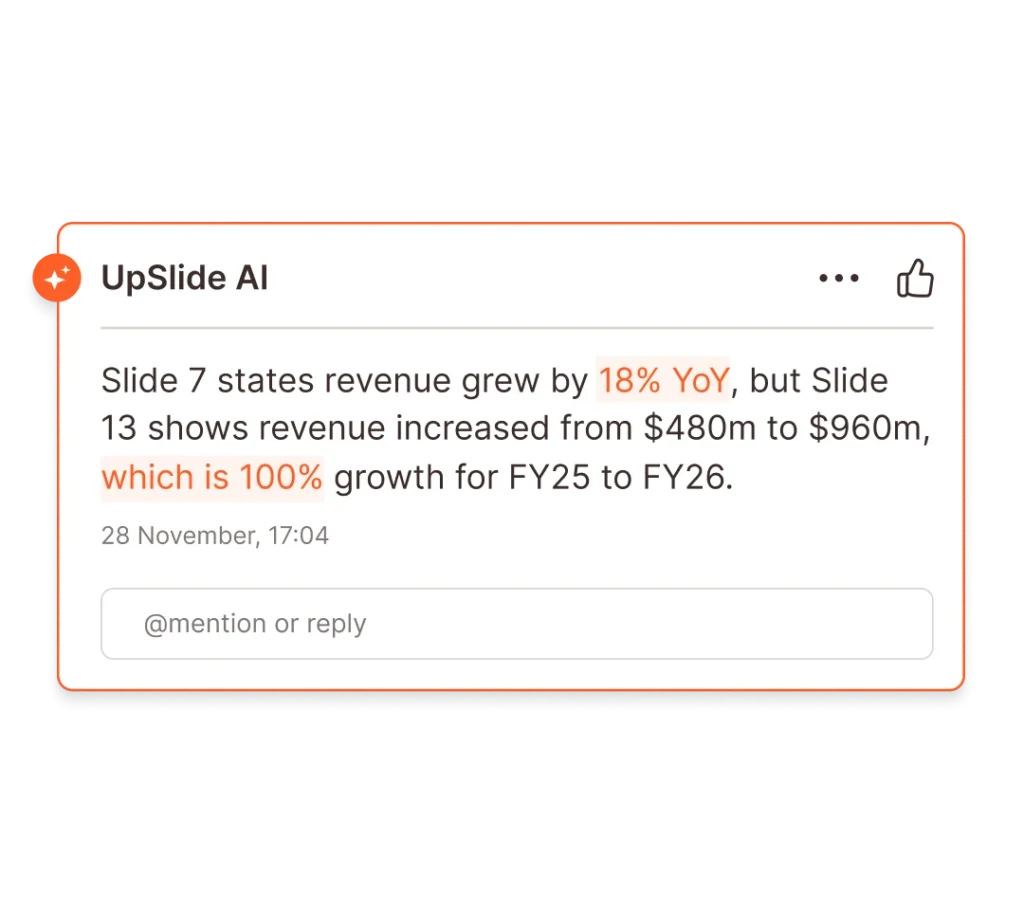
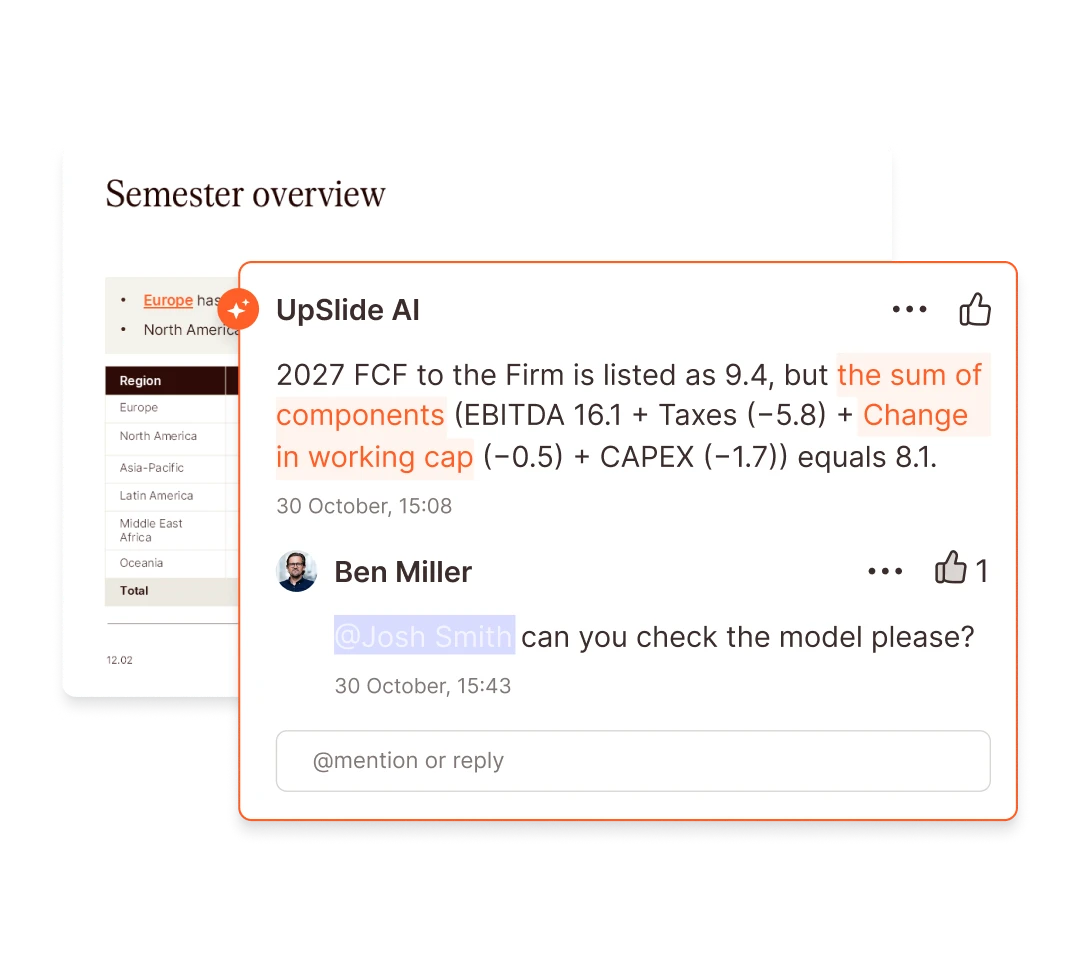
With so many contributors and revisions, figures drift. Before a book goes to the MD, UpSlide’s AI Consistency Check reviews the whole PowerPoint deck, from text and tables to charts and images. It points out figures that disagree between slides, such as an EV/EBITDA multiple quoted one way on the summary page and another way in the valuation section, along with any calculation errors.
When the MD’s comments come back, UpSlide’s Track Changes highlights what changed between drafts, from rewritten bullet points to updated tables and Excel-linked charts, and lets the analyst approve or reverse each change.

Build Pitchbook Pages with Claude and UpSlide
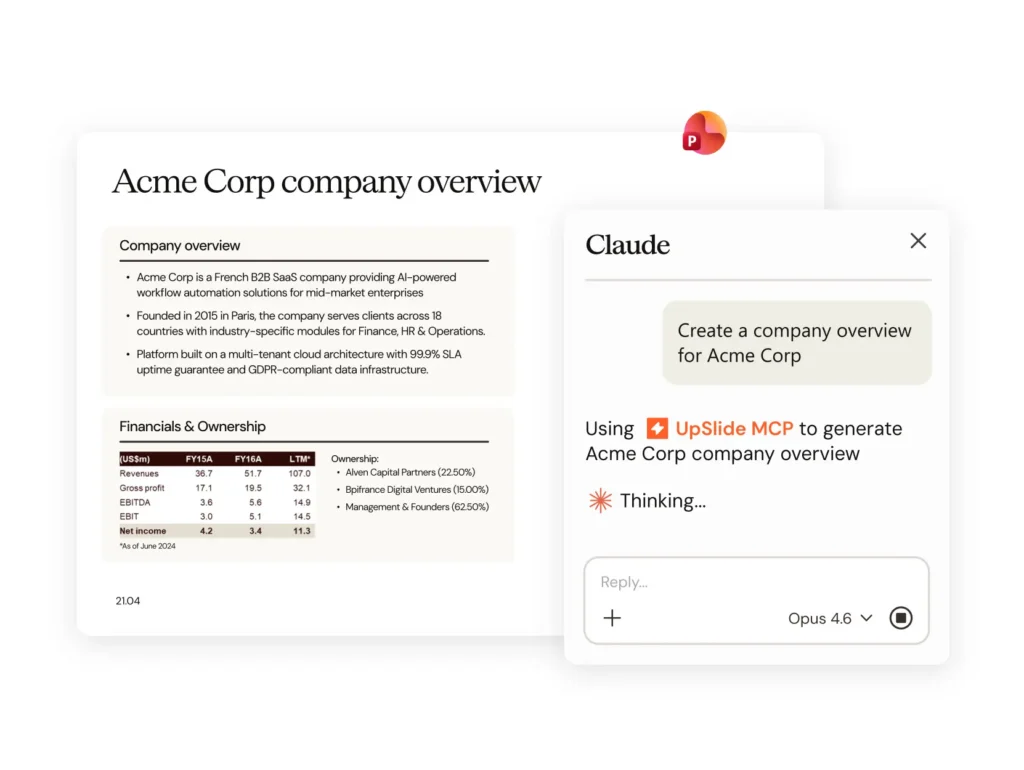
UpSlide’s MCP server gives AI assistants like Claude access to UpSlide’s tools through Model Context Protocol (MCP), the open standard for connecting AI assistants to other software.
An analyst can ask Claude to add the bank’s About Us section, insert tombstones from recent deals, place competitor logos on a slide, or link the comps table to the model. Claude does it using the bank’s own layouts and Library content. Before the pitch goes out, it can also refresh every Excel link in the deck and point out any that have broken.
Due Diligence and Research
In the first weeks of a mandate, diligence and research create most of the reading: data room documents, management presentations, and sell-side notes.
On diligence, AI tools can pull material terms from contracts, map financial statements to your bank’s standard framework, and summarize documents for an analyst to work from. The first pass through a data room becomes a review of outputs that are already tagged.
On research, AI can turn management presentations and sell-side notes into short briefings, so your team gets up to speed on a new company with far less reading. The deal team still verifies the key findings and approves anything a client will see.
Compliance Checks Across the Bank
Outside the deal team, compliance is one of the most mature areas for AI. At banks with trading operations, trade surveillance and communications monitoring tools review every message and trade, flag anything that matches a known risk pattern, and send it to a compliance officer.
Know your customer (KYC) and anti-money laundering (AML) checks work in a similar way. AI tools gather the information a review needs into one file, and a compliance officer makes the final decision on every case.
Less Production Work for Analysts
Analysts and associates work long hours, and much of that time goes on production work around the analysis: reformatting a deck to match a senior banker’s preferences, rebuilding the same section every quarter, or tracking down missing data. UpSlide’s Investment Banking Burnout Report found that bankers spend up to 40 hours a week on manual tasks.
One approved source of content removes a lot of that work. UpSlide’s Library gives your team a single place for slides, charts, tombstones, bios, and disclaimers, so analysts stop rebuilding pages that already exist or asking another team for the latest version. Active UpSlide users in investment banking save seven hours a month on average.
Risks of AI in Investment Banking
Confidentiality
Deal information can move markets if it leaks. Any AI tool that touches it has to meet the bank’s existing standards, including access limited to the people on each mandate, encryption, and an approved deployment model. A tool that falls short won’t pass compliance review.
Accuracy and Judgment
AI handles data processing and defined tasks well. It can’t price a deal, read a client’s reaction in a meeting, or explain a structure to a client who has heard the pitch before.
Figures need particular care. A pitch book repeats the same numbers on many pages, and AI models are probabilistic, so they can return a slightly different answer to the same request. For figures a client will check, use deterministic tools, which return the same output every time.
Token Costs
Banks pay for AI assistants by the token. Asking an assistant to rebuild a comps table or refresh the numbers across a 60-page book uses a lot of tokens, and across hundreds of bankers and pitches the spend becomes a significant budget line. UpSlide’s internal tests found that an Excel link built through Claude with the UpSlide MCP took 80% fewer tokens than the same task done by Claude alone. Excel links created directly in UpSlide need no tokens.
Pace of Change
Banks’ AI programs and the tools behind them change quickly. Avoid plans that depend on today’s leading tool still leading in two years.
Where to Start with AI in Investment Banking
A focused first project is easier to measure and easier to get approved. One way to approach it:
- Pick a document your team builds every week, such as company profiles or pitch books. The work is high-volume, well understood, and separate from investment judgment.
- Measure the hours before and after, so the project’s sponsor can see the time saved.
- Bring IT and compliance into vendor conversations from day one. Integration, data governance, and security cost less to design in early, and the regulatory questions around AI in client work take time to answer.
- Add the next workflow, such as IM assembly or recurring internal reporting.
Investment banking teams at firms including BNP Paribas, UniCredit, Greenhill, and DC Advisory use UpSlide for the production side of this work, from linking models to pitch books to checking figures before a book goes out.
See how deal teams use UpSlide on our UpSlide for Investment Banking page.
FAQs
Are investment bankers being replaced by AI?
No, at least not yet. AI is changing what bankers spend their time on, taking on the repetitive production that used to fill analyst and associate hours, while the analytical judgment, client relationships, and execution accountability clients pay for stay human. The banks getting the most from it treat AI as a tool for their bankers rather than a replacement.
How are major investment banks already using AI?
The clearest picture comes from the biggest names. JPMorgan’s in-house LLM Suite reaches more than 200,000 employees across over 450 production use cases, and the firm estimates up to $1.5 billion in annual value from its AI work. Goldman Sachs is building AI agents with Anthropic to automate trade accounting and client onboarding, and Morgan Stanley’s OpenAI-powered assistant has reached 98% adoption among its wealth advisor teams.
What are the most common AI use cases in investment banking?
The most common AI use cases in investment banking are financial modeling (building and stress-testing LBO, DCF, and comparable-company models), pitch book and CIM production (formatting decks and drafting first-pass narrative), diligence and research (data-room review and company summarization), and cutting the repetitive production behind analyst hours. Each is a data-heavy, well-defined workflow where AI’s speed turns directly into hours saved per mandate.