


Most coverage of AI in private equity concentrates on the deal itself, where the excitement is greatest but there’s least proof it reliably works yet. The use cases actually running in firms today are quieter and more dependable, clustered in the document-heavy, recurring work of diligence, portfolio monitoring, LP reporting, and exit preparation. These processes are well defined, and a mistake is easier to catch before it causes damage.
AI gets your team to a first draft or a first pass quickly. Before that work reaches an investment committee or an LP, every figure has to be correct, the document has to match your firm’s standards, and the analysis has to stand up to questions.
This guide covers seven use cases across the deal cycle and fund operations, which tools handle each one, and where UpSlide fits.
Deal Sourcing and Origination
Sourcing involves huge volumes of data, and it’s mostly handled by dedicated sourcing platforms and general-purpose AI models.
With natural-language search, your team can describe an investment thesis in plain words and get back a ranked shortlist. An analyst can ask for “European specialty chemicals businesses with recent management changes and expanding margins” and skip building filters on industry codes and revenue bands. Market-mapping tools can also build a picture of an emerging sector in a fraction of the time a manual project takes, and suggest adjacent targets your team might not have screened.
The result is a longer list of candidates without adding analysts. The deal team still decides which names deserve its time.
AI in Private Equity Due Diligence
Diligence means a lot of reading. Your advisors send financial, commercial, and legal due diligence reports, and the data room can hold hundreds more documents.
AI tools can pull key terms out of contracts, sort the target’s financials against your diligence checklist, and write a short summary of each document. Associates read the summaries first and open the source only where something needs a closer look. Pattern-recognition models add a second check by flagging line items that don’t fit industry norms, the company’s own history, or management’s guidance.
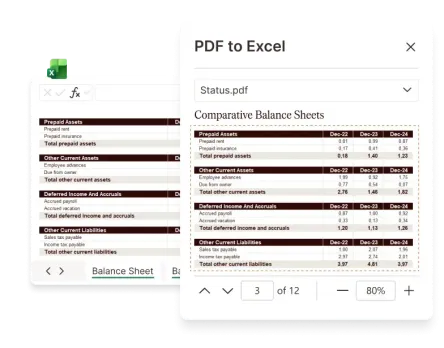
Moreover, a target’s financials often arrive only as PDFs. UpSlide’s AI-powered PDF to Excel lets an associate select a table in the PDF and drop it straight into Excel, with number formats handled automatically. It copies the figures printed on the page and never generates its own, so the numbers feeding your valuation match the source document.
Financial Modeling and IC Memos
AI-assisted tools can build a first draft of a leveraged buyout (LBO) or valuation model from the information package, using historical financials as starting assumptions, and test that the sheets agree. They also make it practical to run many more scenarios across growth rates, exit multiples, financing structures, and downside cases. The committee then sees which assumptions the deal depends on.
A valuation that’s right in Excel but mistyped in the IC memo is still wrong in front of the committee. UpSlide’s Excel Link connects each figure, table, and chart in the memo to its cell in the model, and one click updates them all when the model changes.
Before the memo goes out, UpSlide’s AI Consistency Check reads through the PowerPoint version and flags any internal rate of return (IRR) or entry multiple that appears one way in the summary and another way later on. It also catches calculation errors.

AI in Private Equity Portfolio Monitoring
After closing, AI shifts to tracking how each portfolio company performs against plan. Dashboards from platforms such as S&P Global’s iLevel pull key performance indicator (KPI) data from portfolio companies and flag deviations as they appear. Your operating partners see a cost overrun while there’s still time to act on it.
The quarterly portfolio review pack keeps the same structure from one quarter to the next. UpSlide’s Library holds the approved slides, tables, and disclaimers, and Excel Link ties every figure to the monitoring model. Your team refreshes the numbers and writes the commentary.
Risk and Covenant Monitoring
Specialist tools cover most portfolio risk monitoring. For covenants, they track the underlying financial metrics and warn your team when a breach is getting likely. Early-warning models trained on portfolio company financials go further, spotting pressure on working capital, growing reliance on a single customer, or margins that don’t match management’s commentary.
LP Reporting and Investor Relations
Because LP reports go straight to investors, any error is visible. AI tools can now build a version of the report for each LP, reflecting their holdings, waterfall position, and reporting preferences. That level of tailoring used to take so much manual work that funds offered it to only a few investors. AI can also produce a first draft of the quarterly commentary from portfolio performance data for the general partner (GP) team to edit.
For reports built in PowerPoint, AI Consistency Check flags figures that don’t match from page to page. Park Square Capital, a private credit firm, runs it as a formal review step before performance reports and investor materials go out.
Each round of GP comments produces a new draft. UpSlide’s Track Changes shows every edit between two versions of the PowerPoint report, including Excel-linked tables and charts, so reviewers can accept or reject each one. Every LP’s version starts from the approved slides and disclaimers in the Library.
With UpSlide’s MCP server, your investor relations (IR) team can ask Claude to build the quarterly update from the fund’s approved layouts, add standard disclosures from the Library, and refresh every Excel link once the numbers are final. The tool connects AI assistants like Claude for PowerPoint and Excel to UpSlide using Model Context Protocol (MCP), an open standard for linking AI assistants to other software.

Exit Preparation
Selling a company brings back many of the acquisition documents: a confidential information memorandum (CIM), a data room, and historical financial and operating data a buyer can work through quickly. The sell-side bank usually leads on the CIM. Your team and the company’s management supply much of the content and review each draft.
AI is most useful for assembly. It can sort and tag data room documents, check them against a standard exit checklist, and draft sections from the financials and operating metrics. Comparable transaction analysis can cover a wider range of market scenarios, which helps your team decide when to sell.
Excel Link keeps the figures you hand to advisors tied to the model, and AI Consistency Check flags any that don’t match from page to page as advisors and management revise the deck.
Risks of AI in Private Equity
Data Security
Deal data and portfolio company financials are among the most sensitive information your firm holds, especially during a live process. Any AI tool that handles them should meet your existing standards for access control, encryption, and deployment. Before you sign, find out where the data is stored and who can see it.
Judgment and Accuracy
Decisions on valuation, deal selection, and management quality stay with your investment team, because they drive returns. Every AI output that reaches the IC or an LP needs a reviewer who knows the deal.
Figures need particular care. Generative AI predicts the most likely next word or number, so it can produce a figure that looks plausible and doesn’t appear anywhere in the source. For anything that goes into an IC memo or an LP report, use tools that copy or link numbers directly from the source.
Cost
Cost stops many AI programs. In a 2025 S&P Global survey, 42% of companies said they had abandoned most of their AI initiatives, up from 17% a year earlier, with cost among the main reasons. In private equity, much of that spend comes from tokens, the units AI assistants charge by, and quarterly LP reporting uses them every cycle. In UpSlide’s own benchmark, refreshing Excel links through Claude with the UpSlide MCP cost about 80% less than asking Claude alone, and links refreshed directly in UpSlide use no tokens.
Pace of Change
AI tools for private equity change fast, and this year’s leading vendor may not lead next year. Run a pilot before you scale, and pick tools you could swap out without rebuilding your process.
How to Get Started with AI in Private Equity
Prove one contained workflow first, then expand:
- Start with recurring portfolio and LP reporting. The assembly work is well defined, the hours saved are easy to count, and none of it touches investment decisions.
- Add IC memo production or exit data room preparation next. Both follow the same steps on every deal, which makes the time saved easy to compare.
- Bring IT and compliance into the first vendor meeting. Integration, security, and data governance are easier to settle before a tool goes live, especially when it handles LP data or portfolio company financials.
- Track hours saved each quarter, which makes the case for the next project.
UpSlide supports the document side of this work for private capital firms such as Park Square Capital and Campbell Lutyens. It gets figures out of PDFs, links models to IC memos and LP reports, checks figures before they go out, and keeps fund and portfolio company materials on brand.
FAQs
What are the most common AI use cases in private equity?
The most common AI use cases in private equity are deal sourcing (screening market data for targets), due diligence (document review and anomaly detection), portfolio monitoring (dashboards that flag KPI deviations), and LP reporting (compiling and personalizing updates from live portfolio data). What they share is a high volume of data and a well-defined process, which plays to AI’s strengths in a PE setting.
How is AI used in private equity operations?
In operations, AI sits outside the deal cycle and focuses on running the firm and its portfolio. That covers dashboards monitoring portfolio company KPIs, reporting tools that refresh LP and internal packs each quarter, and compliance checks across the portfolio. The effect is that AI absorbs the repetitive parts of running a fund, so operating partners spend more time on the work that adds value.
Is AI reliable enough for private equity decision-making?
AI is reliable for narrowing, flagging, and speeding up analysis, which makes it well-suited to the document-heavy parts of the job. Final investment decisions, valuation calls, and management assessments still need human judgment and sign-off. Used as an assistant to the investment team it’s dependable, and used as a substitute it isn’t.