

Financial services teams live in a world of perpetual document production. Whether it’s pitch decks for investor meetings, quarterly reports for stakeholders, or investment memos for decision-makers, the volume is relentless. These documents don’t just need to be created – they evolve rapidly, often going through dozens of iterations as deals progress, numbers update, and strategies shift.
The challenge? Review is absolutely critical in finance, but it’s becoming increasingly manual and time-consuming. As deadlines compress and teams juggle multiple projects simultaneously, errors and inconsistencies creep in, often during those frantic final hours before a deadline. A mismatched figure between slide 5 and slide 23. A narrative claim that no longer aligns with updated financial projections. A calculation error that propagates across multiple sections.
This is where AI document review tools are transforming how finance professionals work. By automating the detection of inconsistencies, these tools catch the errors that slip past even the most diligent human reviewers, before they damage credibility or derail deals.
In this blog, we’ll explore what these tools are for, how they can help your firm and how to choose the best solution for your teams.
Why Document Review is Different in Financial Services
Document review in finance isn’t just about catching typos or polishing prose; it’s a fundamentally different challenge with far higher stakes than in most other industries. The documents finance teams produce directly influence critical business decisions, from investment allocations to strategic pivots to regulatory compliance. In this environment, consistency isn’t just about aesthetics or professionalism; it’s about trustworthiness and accuracy.
High-Stakes, Decision-Driven Documents
Financial documents carry exceptional weight because they drive decisions worth millions or even billions of dollars. When a venture capital partner reviews a pitch deck, they’re not just evaluating your business, they’re deciding whether to commit significant capital. When a board reviews quarterly results, they’re determining strategic direction and executive performance. When regulators review your disclosures, they’re assessing compliance and potential enforcement actions.
Multiple Contributors and Late-Stage Changes
Unlike many documents that flow through a linear creation and review process, financial presentations are living documents that evolve continuously. They’re touched by multiple contributors: analysts build the models, associates create the slides, managers review the narrative, partners refine the strategy – each adding their expertise but also introducing potential points of disconnection.
Each change creates ripple effects. Update the revenue figure in your financial model, and that percentage growth rate on slide 4 needs to change. Revise your market size estimate, and your penetration rate on slide 18 is now incorrect. Adjust your EBITDA projection, and your margin claim in the executive summary is wrong.
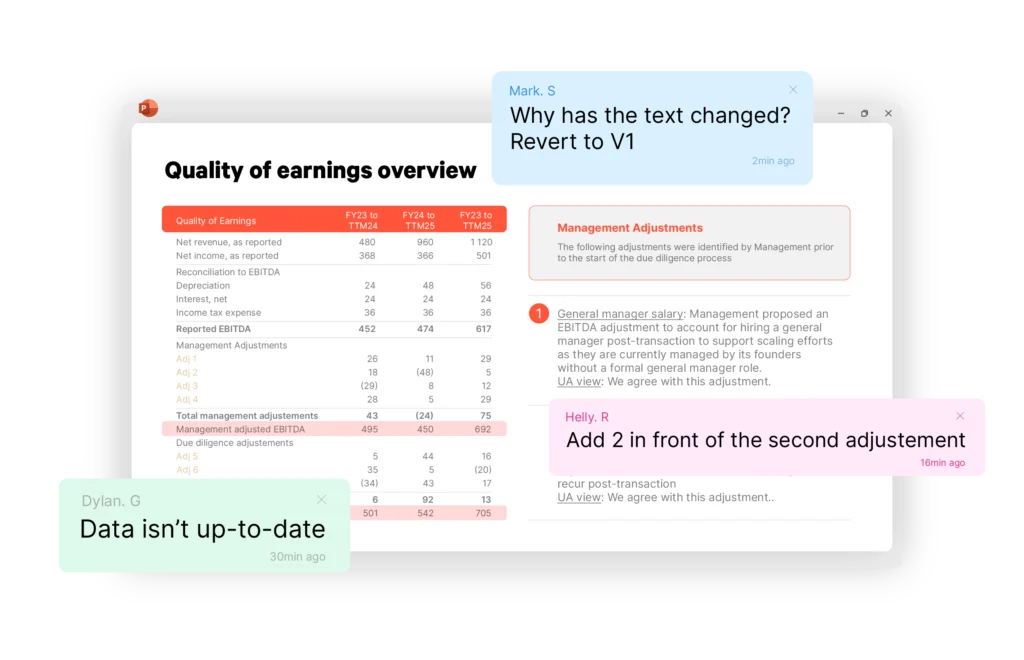
With multiple people making these updates under tight deadlines, it’s nearly impossible to manually track every interdependency. This is where inconsistencies creep in: not through carelessness, but through the sheer complexity of maintaining coherence across dozens of interconnected data points.
Regulations, Compliance, and Client Expectations
Finance operates in a heavily regulated environment where accuracy isn’t optional, it’s legally required. In this context, material inconsistencies in documents can trigger regulatory scrutiny, compliance violations, or legal liability.
Beyond regulation, client and stakeholder expectations in finance are exceptionally high. Investors expect institutional-grade materials. Board members demand precision. Clients evaluate your competence (partly) through the quality and consistency of your deliverables. A marketing presentation might tolerate minor inconsistencies without consequence, but a financial document is held to a different standard.
Manual review processes, no matter how rigorous, struggle to catch every inconsistency when documents contain hundreds of data points across dozens of slides, all updated multiple times daily. This is precisely why AI document review tools have become essential for modern finance teams.
What Are AI Document Review Tools?
AI document review tools leverage artificial intelligence to automatically scan, analyze, and validate documents for errors, inconsistencies, and potential issues. In the context of finance, these tools go beyond simple spell-checking to understand the relationships between numbers, narratives, and calculations throughout a document.
How they work
Modern AI-assisted document review tools for finance use machine learning algorithms to:
- Parse document structure: Identify tables, charts, text boxes, and their relationships
- Extract data points: Recognize numbers, percentages, dates, and financial metrics
- Cross-reference information: Compare figures across different sections and slides
- Validate calculations: Check formulas and mathematical relationships
- Analyze narrative consistency: Ensure written claims align with supporting data
The best AI review in finance doesn’t just flag obvious errors, it understands context. It knows that revenue growth mentioned in a summary should match the percentage change shown in your revenue chart. It recognizes when a valuation multiple cited in text doesn’t align with the actual numbers in your model.
AI Review in Finance: Key Use Cases
AI document review tools can be indispensable across various financial workflows:
Pitch Deck Reviews
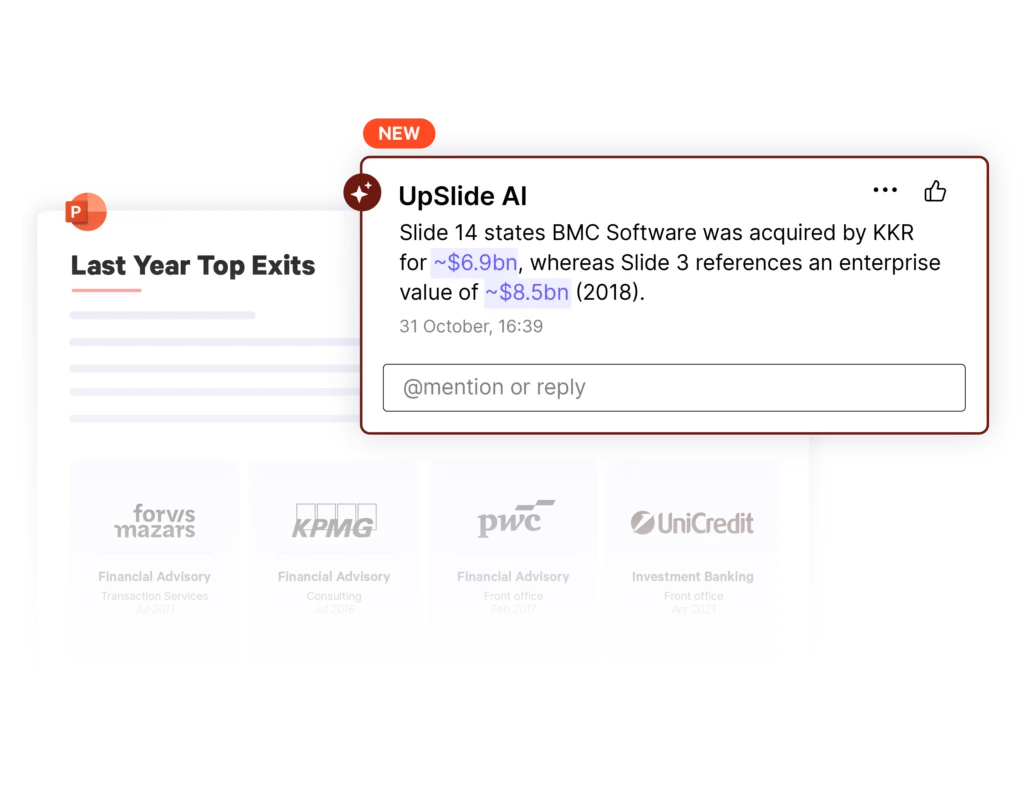
Investor presentations are high-stakes documents where inconsistencies can be deal-breakers. AI pitch deck review helps identify:
- Mismatched metrics between executive summary and detailed slides
- Inconsistent company descriptions or value propositions
- Financial projections that don’t align with historical data
Financial Reports and Presentations
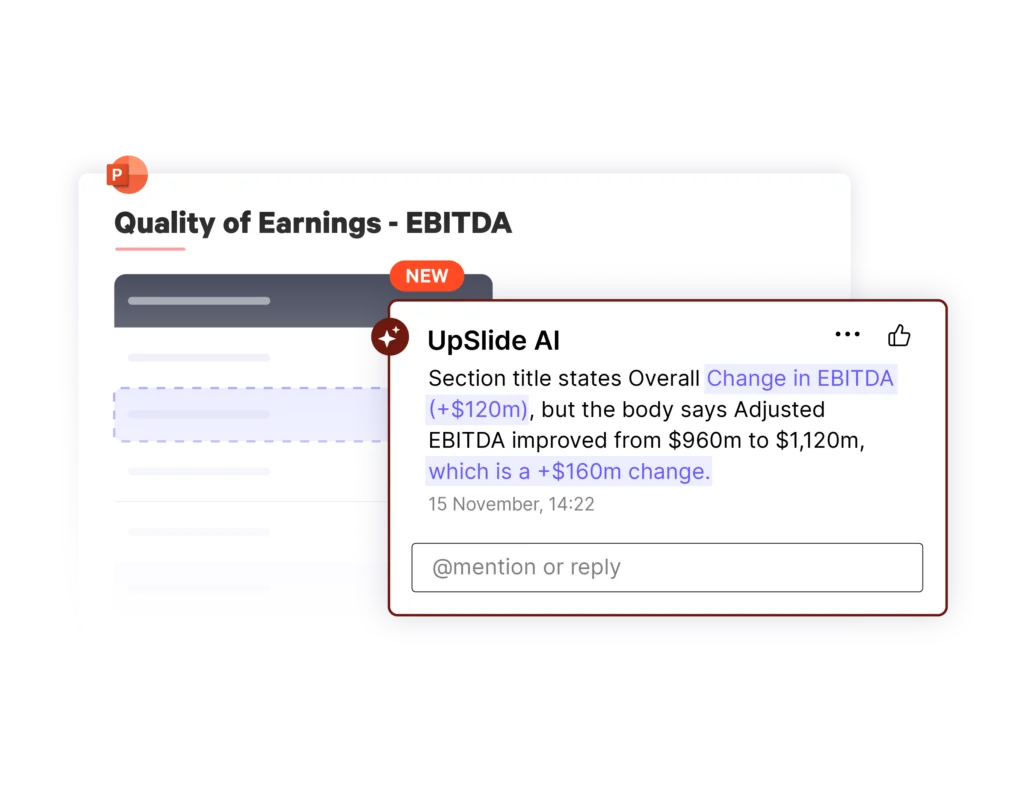
Quarterly reports, annual presentations, and management briefings contain dense financial information. AI tools catch:
- Calculation errors in tables and charts
- Discrepancies between narrative and numbers
- Year-over-year comparisons that don’t add up
- Incorrect totals or subtotals
Investment Memos
Investment committees rely on accurate memos to make multi-million dollar decisions. AI review ensures:
- Deal metrics are consistent throughout the document
- Assumptions stated in text match those in financial models
- Returns calculations are correct
- Comparable company data is accurately presented
Board Presentations
Board decks synthesize complex information for crucial oversight discussions. AI-assisted review validates:
- KPIs are consistently defined and calculated
- Strategic narratives are supported by data
- Budget vs. actual comparisons are accurate
- Multi-period trends are correctly displayed
How to Choose the Best AI Document Review Tool for Finance
Not all AI document review tools are created equal, especially when it comes to the specialized needs of financial services teams. Here’s what to evaluate:
Finance-Specific Capabilities
Generic document review tools might catch spelling errors, but finance requires specialized understanding. Look for tools that:
- Recognize financial terminology and conventions: The tool should understand concepts like EBITDA, IRR, valuation multiples, and growth rates
- Handle complex calculations: Beyond simple addition, the tool should validate percentage changes, ratios, and multi-step formulas
- Understand financial document structures: It should recognize common elements like executive summaries, financial statements, and appendices
Integration with Your Workflow
The best AI pitch deck review tool is one your team will actually use. Consider:
- Native integration: Does it work within PowerPoint, Excel, or Word – your existing environment, or require exporting files to external platforms?
- Speed: Can it review a 50-slide deck in minutes, or does it require lengthy processing?
- Ease of use: Is the interface intuitive enough that team members will adopt it without extensive training?
Scope of Review
Different tools offer different levels of analysis. Evaluate whether the tool can detect:
- Calculation errors: Mathematical mistakes in formulas and computations
- Cross-referencing issues: The same figure appearing differently in multiple locations
- Narrative-data mismatches: Claims in text that aren’t supported by underlying numbers
For a comprehensive AI review in finance, you want a tool that addresses all these dimensions, not just one or two.
Accuracy and False Positives
An AI document review tool that flags every number as potentially incorrect is worse than useless, it creates noise and wastes time. Look for:
- Contextual awareness: The tool should recognize when apparent inconsistencies are intentional (like showing both rounded and precise figures)
- High precision: The tool should accurately identify genuine errors without excessive false alarms
- Clear explanations: When it flags an issue, you should understand exactly what’s wrong and where
Security and Confidentiality
Financial documents contain sensitive information. Ensure the tool:
- Processes data securely: Documents aren’t uploaded to external servers unnecessarily
- Maintains confidentiality: Your proprietary information isn’t used to train public AI models
- Complies with regulations: The tool meets your industry’s data protection requirements
Scalability and Support
As your team adopts AI-assisted document review, consider:
- Team licensing: Can multiple users access the tool efficiently?
- Support quality: Is there responsive technical support when issues arise?
- Updates and improvements: Is the vendor actively enhancing the tool’s capabilities?
Return on Investment
Finally, evaluate the practical impact:
- Time savings: How many hours of manual review does the tool eliminate per document?
- Error reduction: How significantly does it reduce the number of inconsistencies in final deliverables?
- Risk mitigation: What’s the value of avoiding even one embarrassing error in a high-stakes presentation?
The right AI document review tool should pay for itself many times over through increased efficiency and reduced risk.
Introducing UpSlide AI Consistency Check
This is exactly why we built AI Consistency Check: a purpose-built AI document review tool designed specifically for financial presentations.
AI Consistency Check automatically scans your PowerPoint presentations to identify three critical types of errors:
- Calculation Errors Every formula, percentage change, and mathematical relationship is verified. If the numbers don’t add up, you’ll know instantly.
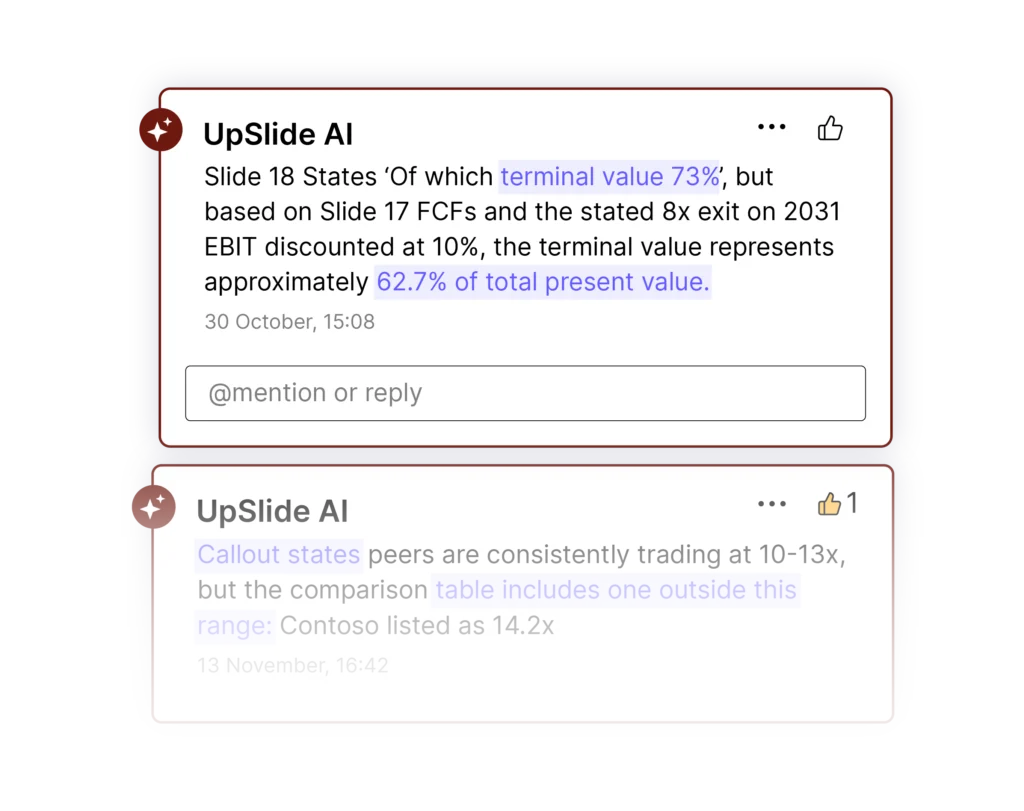
- Narrative Inconsistencies Claims in your text boxes or visuals are cross-referenced with supporting figures throughout the presentation. When narratives and numbers tell different stories, AI Consistency Check alerts you.
- Figure Discrepancies The same metric appearing in different locations, whether it’s revenue in the executive summary and the financial detail, is validated for consistency.

Consistency Check flagged differences in reported cash levels, even though these stemmed from different sources and calculation methods. It is remarkable that the AI picked this up, even in data presented in image formats.

Built for Finance Teams
AI Consistency Check understands the financial context of your documents. It recognizes industry-standard metrics, and handles complex financial calculations.
Works Where You Work
No exports, uploads, or context-switching required. AI Consistency Check operates directly within PowerPoint, reviewing your presentation in seconds and providing a clear report of any issues found. Your documents stay secure on your system.
Saves Time for What Matters
Instead of spending hours manually cross-checking across dozens of slides, your team can focus on strategic analysis, compelling narratives, and stakeholder preparation. AI Consistency Check handles the exhaustive validation work and the tick-and-tie, freeing your experts to apply their judgment where it matters most.
For finance teams producing multiple presentations under tight deadlines, AI Consistency Check acts as an always-on quality control layer, catching the errors that inevitably slip through when you’re racing against the clock.
Conclusion: The Future of AI-Assisted Document Review in Finance
In finance, credibility is currency. Every inconsistency in your presentations, no matter how small, chips away at the trust you’ve worked so hard to build with investors, clients, and stakeholders.
AI document review tools aren’t about replacing human expertise; they’re about augmenting it. They handle the exhaustive, detail-oriented work of validating hundreds of data points, freeing your team to focus on strategy, storytelling, and relationship-building: the high-value work that truly differentiates your organization.
As documents grow more complex and deadlines grow tighter, the teams that thrive will be those who leverage AI-assisted document review tools to maintain the accuracy and consistency that financial stakeholders demand, while preserving their experts’ time for the judgment, context, and strategic thinking that no algorithm can replicate.
Ready to eliminate inconsistencies from your financial presentations? Discover how UpSlide AI Consistency Check can protect your credibility and save your team hours of manual review.
TL;DR
Finance teams face a unique document challenge: High-volume presentations evolve rapidly under tight deadlines, with errors and inconsistencies often introduced during late-stage changes by multiple contributors.
The stakes are exceptionally high: In finance, document inconsistencies directly undermine decision-making credibility, whether in pitch decks, board presentations, or regulatory filings, where accuracy isn’t optional.
AI document review tools automate exhaustive validation: These tools verify calculations, cross-reference figures across slides, and check narrative-data alignment in seconds, work that’s virtually impossible for humans to do comprehensively.
UpSlide’s Consistency Check strengthens accuracy and coherence across PowerPoint and Excel-based deliverables, improving both speed and decision‑making.
AI amplifies human expertise, doesn’t replace it: By handling mechanical validation, these tools free finance professionals to focus on judgment, strategic context, and narrative coherence: the high-value work that truly matters.
UpSlide AI Consistency Check is purpose-built for finance: It identifies calculation errors, narrative inconsistencies, and figure discrepancies directly within PowerPoint, acting as an always-on quality control layer for financial presentations.