








The AI-powered stack for financial services is starting to take shape.
AI is already changing how teams build presentations, reports, and models. What used to take hours can now take minutes. A first draft can be produced more quickly and developed with far less friction than before.
That shift is real, and it matters.
But in financial services, the value of a deliverable does not come from how quickly version one appears. It comes from how that draft is refined, checked, and brought to a standard that can win deals, help make better decisions and withstand internal and client scrutiny.
In other words, the challenge is not just getting to v1. It is getting from v1 to vFinal quickly and with confidence in the output.
That is where UpSlide fits.
TL;DR
For the past 15 years, UpSlide has been the Microsoft 365 add-in for financial services – helping teams build, refine, and deliver high-stakes documents with accuracy, consistency, and control. Our mission is even more relevant in an AI-first world.
As AI assistants, such as Copilot, Claude and ChatGPT, become embedded across financial workflows, UpSlide extends its role by guiding, improving and verifying their outputs, ensuring drafts are structured, accurate, on-brand, connected to live data, and aligned with firm standards from the start.
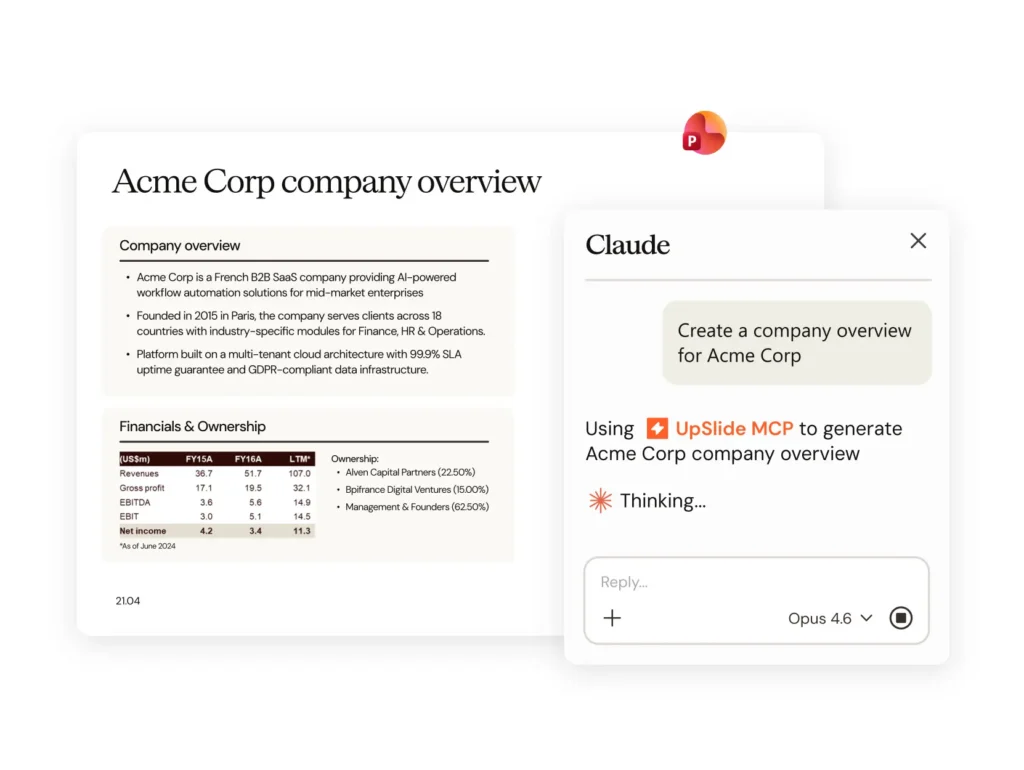
This is made possible by exposing UpSlide capabilities via MCP, allowing generalist AI assistants, like Claude or Copilot, to apply templates, pull from content libraries, structure presentations, and maintain data integrity as they generate content.
Alongside this, and through every iteration and review cycle, UpSlide combines standalone AI agents and deterministic workflows – from refinement and verification to formatting, Excel linking, and Track Changes – to keep the deliverable accurate, consistent, and client-ready.
The result is not just faster drafting, but a more reliable way to move from draft to final deliverable, quickly, and with full confidence in the output.
Rethinking Deliverables: Why Complexity Builds in Financial Workflows
We believe everyone in financial services will coalesce around three foundational AI assistants from model providers, namely Copilot, Claude, OpenAI. At least one will be available to all financial services professionals (and agents), embedded end‑to‑end in the creation of M365 deliverables.
These AI assistants are already changing how teams get started in Microsoft 365. But once a first draft exists, the workflow becomes far less linear.
Research, modeling, drafting, and review all happen in parallel, across tools, teams, and multiple iterations. Content is reused, reworked, and merged. Numbers are updated. Assumptions change. Stakeholders add comments, often late in the process.
A pitchbook can look polished at first glance and still contain inconsistencies. A due diligence report can be mostly on-brand and still require hours of cleanup. A model can be mostly right and still introduce risk.
These deliverables evolve continuously. When multiple contributors, large volumes of data, and tight deadlines are involved, small issues compound quickly.
What starts as a clean first draft can quickly become difficult to control:
- numbers drift out of sync
- formatting becomes inconsistent
- outdated content remains in circulation
The challenge is not simply producing a draft.
It is maintaining accuracy and control as that draft evolves into a client-ready deliverable.
UpSlide Across the Future Document Lifecycle in Financial Services
At UpSlide, we’re excited to see new, simpler ways to produce top-tier Microsoft 365 deliverables becoming a reality.
Having worked for over 15 years with finance professionals, we also see that a key layer is still missing in the document creation workflow, and that’s where we come in.
UpSlide is the specialist document production layer that helps financial teams build, refine and verify high-stakes deliverables they can trust.
UpSlide does not just sit alongside AI, it integrates directly into the workflow. As content moves from research and modeling into Microsoft 365, UpSlide functionality is applied to structure, format, connect and verify that content to live data.
Powered by a combination of MCP-enabled AI orchestration, purpose-built AI agents, and deterministic workflows embedded directly in Microsoft 365, this ensures that even AI-generated drafts meet firm standards from the start.
In practice, this means we can support financial services firms across every step of the document lifecycle:
Building with UpSlide
An analyst, or their agent, asks an AI assistant to build the first version of a deck.
Instead of starting from a blank structure, the assistant can call UpSlide capabilities via MCP as it generates the content. The table of contents is created and kept in sync, slides are structured using approved templates, and content, such as logos, bios, or tombstones, is pulled directly from internal libraries.
AI can generate content. UpSlide ensures that content is structured, on-brand, and immediately usable within financial workflows from the start.
The result is a draft that already reflects firm standards structurally, visually, and contextually, before any manual or further AI-powered refinement.
Refining with UpSlide
Once the draft exists, the real work begins.
Numbers change. Slides are reworked. Sections are added. Content is pulled together from different contributors. Under time pressure, documents tend to drift: formatting becomes inconsistent, data falls out of sync, and small issues accumulate.
This is where AI-only workflows typically fall short: iteration introduces drift, inconsistency, and hidden errors.
UpSlide helps teams keep the document aligned as it evolves.
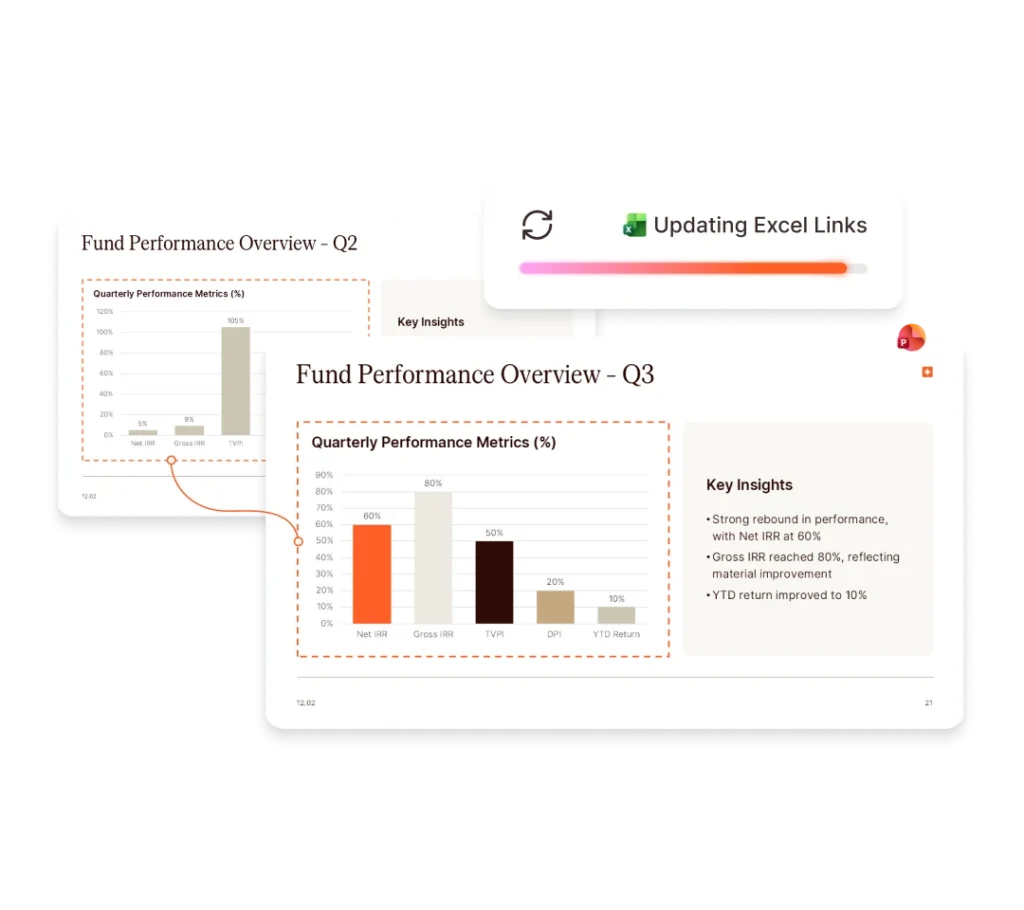
Whether iterating by hand, using our content refinement AI agent, or leveraging UpSlide capabilities through MCP inside embedded AI assistants, the deliverable stays under control: formatting remains consistent, Excel links can be created and refreshed, and sections can be extended or reorganized without breaking the flow. The structure holds together in real time, right in front of you.
This means teams can move through iterations without constantly having to fix what was broken in the previous step, making it easier to get from v1 to vFinal without slowing down.
Reviewing with UpSlide
Review is where risk becomes visible.
A number looks slightly off. A stakeholder asks what changed since the last version. A model needs to be validated before the output built on top of it can be trusted.
At this stage, two questions matter: can you trust the numbers, and can you clearly see what has changed?
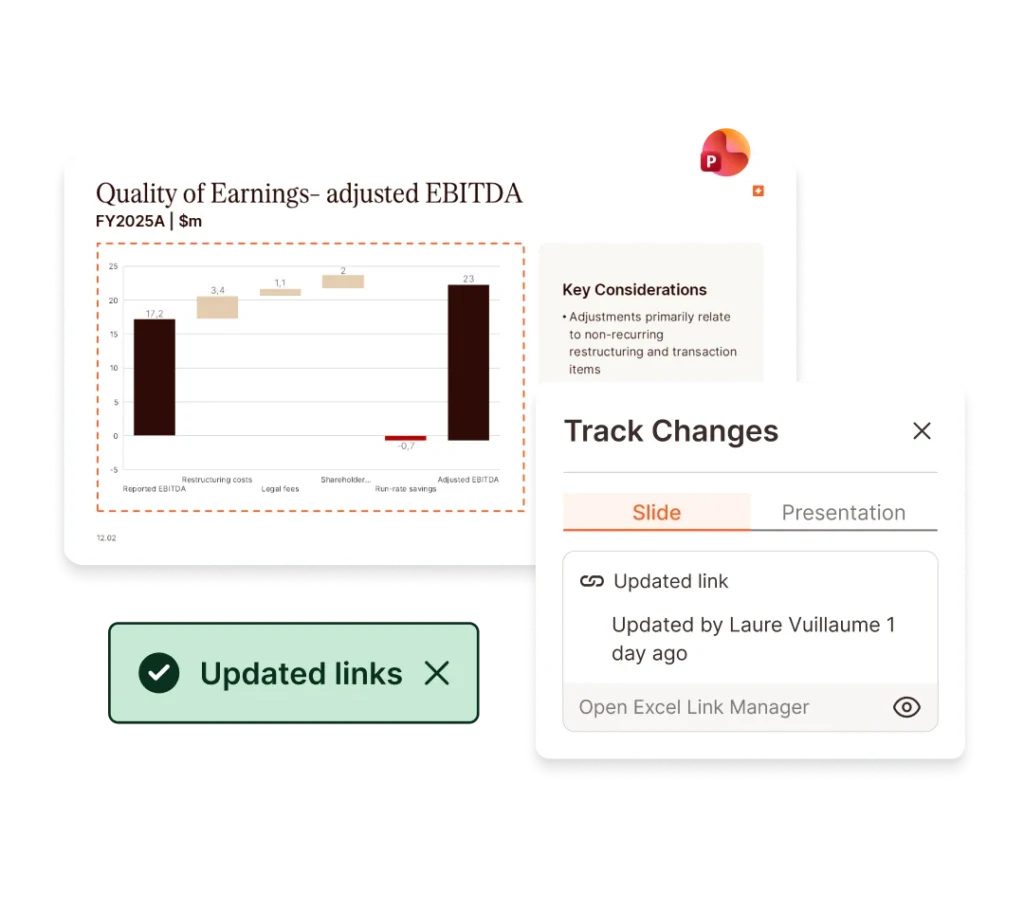
UpSlide addresses both. In Excel, advanced modeling tools help validate the integrity of the underlying data. In PowerPoint, Track Changes provides a clear view of what has been modified across versions, so reviewers can focus on what actually changed rather than rechecking everything.
AI can generate new versions, but it does not reliably track, explain, or validate changes across iterations. UpSlide brings that visibility and control into the review process.
Instead of slowing down under the weight of manual review, teams can move faster with greater confidence.
Verifying with UpSlide
Before a document is sent, there is always a final check.
Is everything consistent? Are the numbers up to date? Does the narrative hold together?
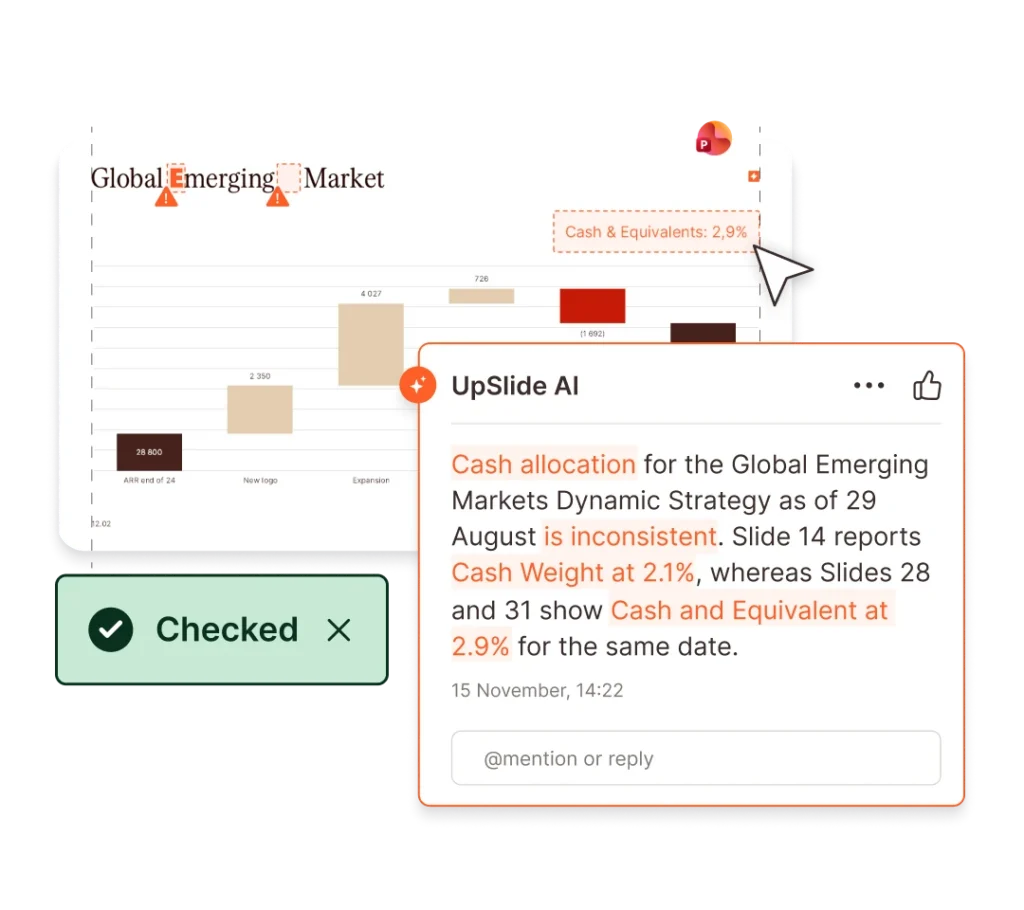
UpSlide provides a structured way to answer those questions using a purpose-built, finance-grade AI verifying agent.
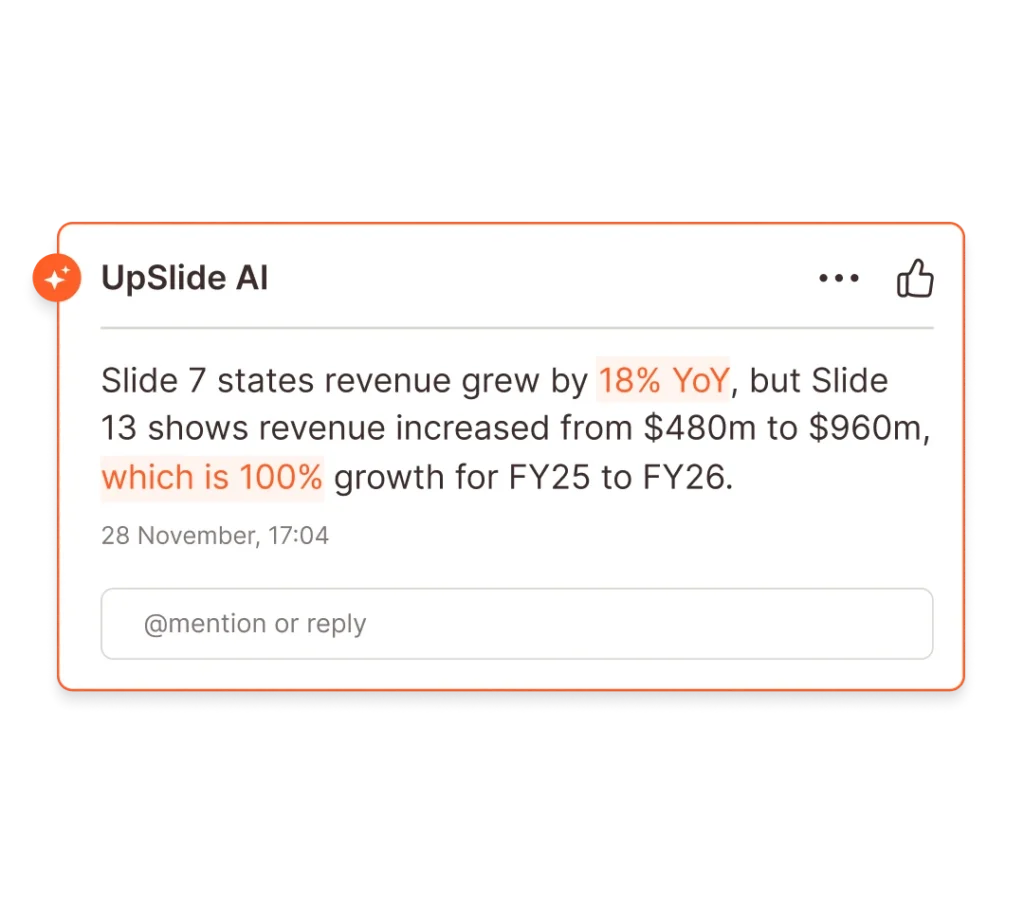
With AI Consistency Check, teams can automatically detect inconsistencies across the document, whether in narrative or figures, before it is shared.
Final validation cannot rely on probability. Even as LLMs improve, they remain non-deterministic. UpSlide ensures deliverables are systematically verified before they are sent.
Rather than relying on a last-minute scan or a rushed review, teams can deliver with confidence, knowing the document has been validated as a whole.
UpSlide Is Built for the Part of the Workflow Generalist AI Can’t and Won’t Solve Alone
UpSlide changes not just how documents are created, but how they are delivered.
It ensures that outputs are aligned with firm standards from the start, remain consistent as they evolve, and can be updated, reviewed, and verified without introducing risk or inefficiency.
This results in:
- Client-ready AI outputs from v1: UpSlide injects determinism into PowerPoint, Excel, and Word, so firms get the same correct outcome every time. LLMs continue to improve, but they remain probabilistic – quality increases, not consistency. With UpSlide MCP, AI assistants can trigger production-grade actions, not just generate text.
- Better performance with hybrid AI, not pure inference: UpSlide combines LLMs with classic machine learning and deterministic algorithms. This goes beyond prompt-only approaches. The result is higher precision, lower variance, and more consistent outputs – at a lower cost.
- Embedded iteration workflow inside M365: UpSlide supports review, iteration, and approval directly inside Microsoft 365. Teams and agents can collaborate in a single, purpose-built environment. General AI tools focus on generation; UpSlide enables end-to-end execution.
- Reduced total cost of ownership as volume grows: As AI increases the number of documents and versions produced, costs can scale quickly. UpSlide reduces the marginal cost per iteration through reusable assets, automation, and governance. This makes each additional document faster and cheaper to produce – especially as token pricing evolves.
Why This Matters – Today and Tomorrow
Today, AI is changing how work starts.
Tomorrow, it will be embedded more deeply across workflows. More content will be generated by more people and agents. That increases productivity, but also the need to ensure all deliverables meet the standards, quality, and trust required in financial services.
At UpSlide, we welcome horizontal AI platforms to help financial teams discover and benefit from our AI capabilities – increasing productivity through faster, more comprehensive, lower-cost, and more deterministic AI-powered document production.
While AI pure players like Anthropic, Microsoft, and OpenAI fight for dominance as the horizontal AI distribution layer and LLM monetization, UpSlide will continue compounding value in its vertical: high-stakes financial deliverables inside Microsoft 365.
Because in financial services, quality is not a finishing touch; it is part of the value being delivered.
And the firms that succeed will be the ones that can turn speed into client-ready deliverables that are on point, on brand, and on time – every time.
Discover how UpSlide helps financial teams turn AI-driven productivity into client-ready outputs.